


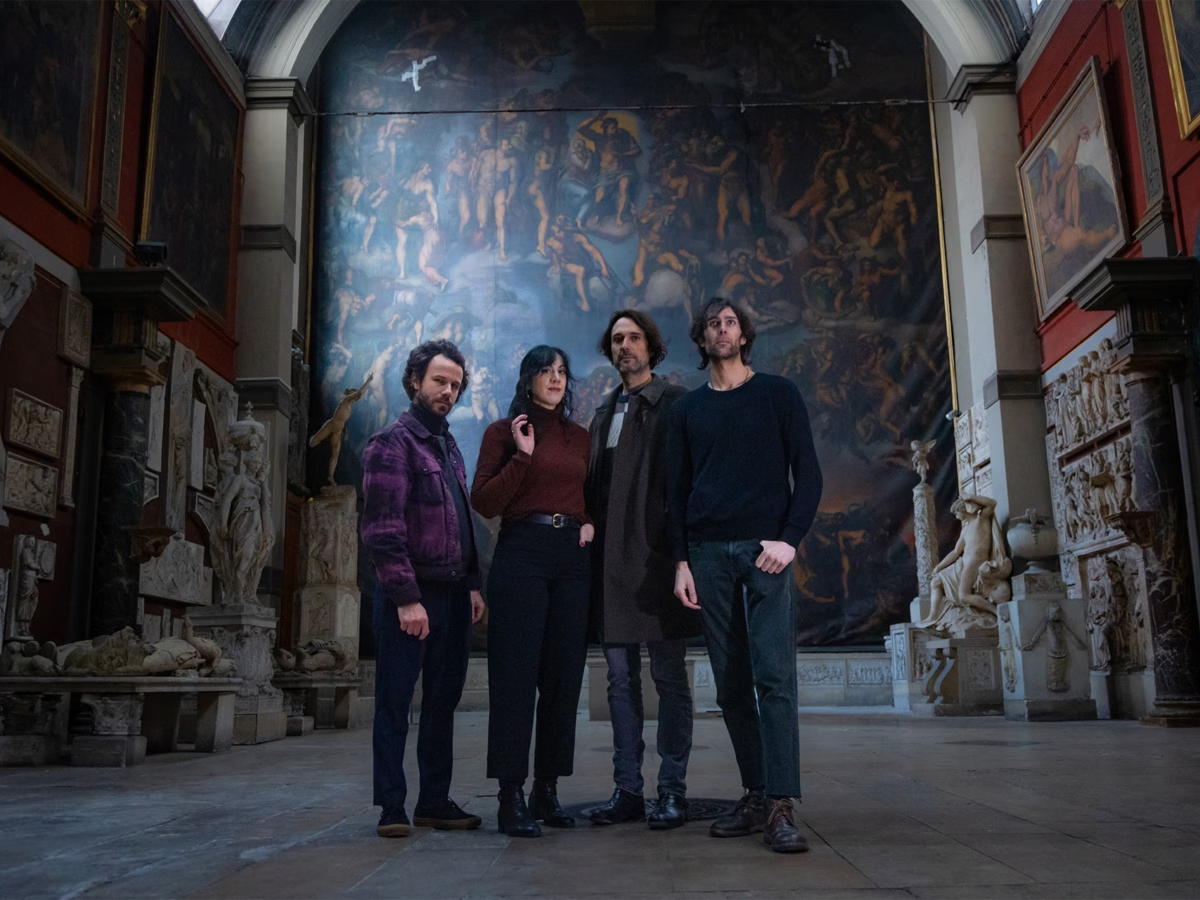
“If you think for just one second, it’s already late.” It’s hard staying fully present in the moment, that state of immovable focus, laser sharp and fully receiving of everything and anything in its surroundings. Finding that in daily life feels like a dream reserved for shepherds and meditation retreats, but in music, you have the chance to fully surrender to the needs and flow of the song, let the self melt and the sound lead instead.
I’m always looking for a band like that, a band whose sound thins the barriers of your conscious mind and sets the unconscious free to roam and travel wherever it may wish. My life-long love for Wardruna and their first album, the immediate connection to OM‘s Advaitic Songs. It has to feel right. It has to feel truthful.
I found that anew in the Parisian quartet Bank Myna.
Brought together by an ad posted by vocalist/violinist Maud, it was “friendship at first sight” with bass player Daniel and an immediate music connection that led to the band we know today. Pulling from influences as diverse as Warpaint, Björk and Arc of Fire and vocal queens like PJ Harvey or Patti Smith, the Bank Myna of today blends shamanic slow doom with heartfelt lyricism and a solid wall of distortion and noise to terrify you out of normal frequency. While the trance in the listener is immediate, the band also enter a different mind space.
Maud: If I’m thinking about something when we play, it means I’m not doing great. Usually I don’t think about anything except for the present tense and what I’m doing right now and how I’m feeling and what my body is doing. I think the “letting go” part is absolute on stage. For my part, I’m in a kind of second state. I remember one time, I completely missed parts of the song that are heavily based on vocals. The guys had to follow me and I just didn’t realize at all, I was in such a second state that to me it just flowed naturally. It’s easier when there’s an audience involved too.
Dani: Maybe not the first time we play a song live, because then you’re more concentrated, but once the machine is running, you just flow with it.
Do they think about their audience much when they perform?
Constantin: For me, I try not to take care of the audience, that would disturb my focus. When you talk about an altered state, for me this alteration is when you really go into it, you are really focused, that means you don’t think about anything, you’re just into it.
My father used to be a musician as well and we were talking about this, about overthinking during playing. And he told me, if you think for just one second, it’s already late. So I tried to be really into it, but just focus on what we are doing, what I am doing and playing the music as perfect as we can.
Dani: I like to look at my bandmates, but also the audience. I have a kind of second state at some point, while also staying conscious about what is happening around, my head is kind of split in two. And at the end, probably if I feel the audience is not so receptive, I concentrate more on the band. It’s more awareness than communion.
Maud: I think for my part it’s kind of different because for the whole Volaverunt era, I was quite shy and I always felt comfort in playing together and maybe not interacting that much with the audience. Because to me it was really terrifying. And I don’t know, it kind of worked this way because it was very immersive. It was an immersive experience. We never stopped playing from start to finish during the show. And I think for this new set, it’s a little bit different. Just going in front of the audience and facing them is kind of a new experience for me. It’s also still kind of terrifying every time I do it, but it’s somehow, I don’t know, I’m kind of grateful as well to do that because then I can see the reaction our music has on the audience and so it’s kind of nice discovering that as well.
Dani: I think sometimes it’s terrifying for them as well. Now you’re really going and confronting, looking at people. It makes sense because it’s a very tense, a little disturbing part of the album.
Maud: They probably think I’m nuts because I look kind of crazy.
Dani: But I think it fits with this part of the music, this energy and this going to seek the people.
There is a great change in sound between their first EP Bank Myna and their first album Volaverunt. The shoe gaze dream pop lightness sinks under a much darker gloomier atmosphere, more distortion and sonic violence, but the soaring voice remains untethered still, you can hear the threads of Scandinavian artists like Robin or Aurora. In the 6 years between releases, one of the contributing factors was the departure of their original drummer.
Dani: We had a concert that we wanted absolutely to do. So we took everything we were composing and created a set with drum machines. [It was] a very long track that had a lot of experimental looping, sampling one drum and looping it on live and things like that. It became the seed for our first album, ‘Volaverunt’. Then it evolved, and we wanted to play it live, we said, okay, we need drums. That’s when Constantin came.
Maud: We had in mind something quite heavy, but we also wanted someone open to experimentations.
Dani: We were looking for someone able to kick hard, but have sensibility as well. Because we have some guys that were very experimental and with a soft touch, but then we’d need more energy. And there were others that were just energy, energy, but then there’s come an ambient part and they’d need to feel it.
Constantin: Mostly I think about making it percussive first. I played post-rock stuff for almost 10 years before joining Bank Myna. I come from classical music, I’m a big rock fan of bands from the 90s, 2000s and everything and for the last album I wanted to play something a little different than the other doom or metal bands. I tried to go the opposite way of what I would do naturally, so it became more percussive and textured.
One of the very first things I noticed about Bank Myna was the clear conversation that was happening between bass and drums, not unlike OM.
Dani: I discovered OM because of Constantin. In fact, when we were composing Eimuria [their latest album], he infused this kind of vibe, making me listen to it. We wanted to record it live and not put that much into production, like overdubs and everything, we tried to make it quite natural. We’ve been jamming, trying ideas for a long time. But it’s like gymnastics when you write music, it’s quite an exercise, you got to be in a certain state of mind and try to communicate with each other. The most difficult part for me is to start, to get the machine started and then everything goes well afterwards.
Maud: I think it’s quite a heavy machine as well because we write all together. There isn’t someone who writes all the parts and then tells the others what to play, and we’re not the kind of band who records instrument by instrument. Because when you get to try to compose layer by layer, you have tendency to put so many things on that it ends up being a disservice to the main instrument.
With this in mind, they went looking for a place to record Eimuria live, where they “could record at the same time, having at least eye contact”.
Constantin: There was a lot of spontaneous energy when recording. It wasn’t like we’ve been rehearsing the song [over and over again]. Sometimes I listen to an album and I can hear that they’ve been playing it and overplaying it and to me it feels flat, like there’s no feeling. That’s why I don’t really listen to rock music anymore now. I like that spark of spontaneity.
Bank Myna songs easily sprawl into 8-9 minutes of melting vibrations. I was curious how they kept track of where they are in the piece when they themselves flow with the music.
Maud: Maybe it doesn’t feel that way when you listen to them, but it’s pretty well structured. We have names for every tiny little part within the songs. Some parts are called in a funny way and we just call them out loud to technical engineers in the venue, it’s quite funny. We know them perfectly well to the point that we completely forget about it, it just flows, we totally let go of everything and just play.
As for the lyrics, they also arrive from a liminal space.
Maud: You know that stage where like you’re in your bed, you’re gonna fall asleep, but you’re not asleep yet? That’s usually when the words come. I have tons of notes on my telephone with words coming out of nowhere, when I want to sleep but can’t, because the world is calm. It’s usually about personal situations, how I felt at some point in my life, so they’re kind of personal and emotional in a way. It’s a kind of therapy, based on my own experience. And I’m just hoping that people can just feel or be moved by them because in a way it speaks to them.
While their albums don’t necessarily start with a theme, they do emerge.
Dani: In the beginning, we discussed some general ideas, about light, dark light, stone, contrast, some words that were just floating around in the general space as the album was coming together.
Maud: We also tried to link it to two women we really like. First, Camille Claudel, who was a sculptress with a very complicated life, she had a very confusing story with Rodin, who was her mentor and way more famous than her. She was fascinating to me, what she had accomplished despite what society expected from her. And then the other woman was Alejandra Pizarnik, who was a poet, also with a very complicated life, she died early, but she made the most fascinating poetry. It has no structure. It’s simply words and emotions laid out on paper. And I love that because it reminded me of our structures as well, because they’re quite long and don’t always make sense.
Thank you again to Maud, Dani and Constantin for their time and generous storytelling. You can catch Bank Myna live on tour this autumn around Europe with Deûle.
15.10.2026 AMIENS, FR
16.10.2026 DUSSELDORF, DE
17.10.2026 TUBINGEN, DE
19.10.2026 LJUBLJANA, SL
20.10.2026 ZAGREB, CR
21.10.2026 BUDAPEST, HU
22.10.2026 WARSAW, PL
23.10.2026 KATOWICE, PL
Bank Myna are
Fabien Delmas: guitar
Maud Harribey: vocals, keys, violin
Constantin du Closel: drums, percussions
Daniel Machón: bass