



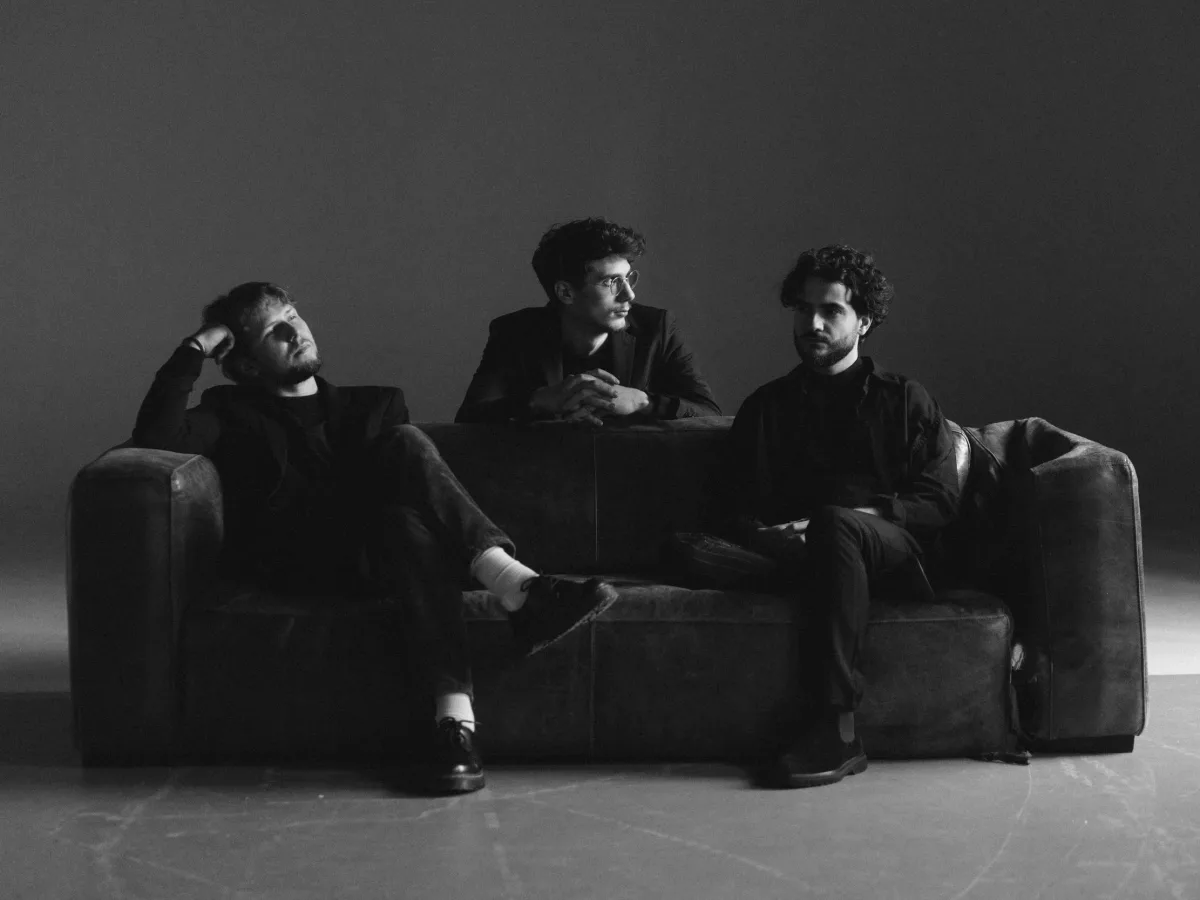
The day has come, my friends, where we introduce a brand new genre to the MJB family. Amphitrio (the Andrei-Mike-Philip Trio) are a contemporary jazz project formed in Bucharest in 2023, with a back catalogue of successes far exceeding their life span. With over 100 concerts already under their belt and awards from far and wide, theirs is an eclectic blend of Romanian motifs, a soft touch and explosive bursts of energy. They will be making their Ronnie Scott’s debut on November 19th 2026, grab your tickets while you can HERE.
We caught up in St Dunstan-in-the-East, the roofless cathedral in central London that felt a fitting metaphor for their limitless approach to jazz.
Philip: When we started this project, we were all coming from different collaborations in the jazz scene in Romania. We had never played together as a trio, but I had played with Andrei in some projects and with Mike in others. We became good friends and when we started, we knew we wanted to create a very professional project, not just play at random. This was the biggest difference because we all had different experiences from our projects and we had seen what didn’t work and what did work, and we came into this trio with all we’ve learned.
Andrei: We try to be consistent in putting music out and make our own opportunities, not just wait for them to come to us. There’s a lot of collaborations on the jazz scene in Bucharest and there’s some emerging projects with original music, but there was a few years gap between the Romanian greats (Johnny Rǎducanu is perhaps the best known outside Romania) that we had learned from and today’s jazz scene. It was like a gap of initiatives and projects, a gap that we tried to fill and that we tried to grow something from it.
One thing they learned is things can go much further when great musicians come together to support each other.
Philip: It’s strange because everybody has a solo project, and other musicians are not interested to grow that one project. If I want to play my own music, I have to make my own project, but we know, there are a lot of bands that have multiple composers, and everybody contributes, like it’s allowed to have different composers and put your creativity together to make even more music.
Mike: It’s a growing scene, but it’s mostly just gigs where people play standards, some classical jazz, and we don’t really have projects that grow and travel, or that really explore composition. We are lucky with Andrei, because he’s our composer and he’s based in composition.
Philip: What I’ve seen as the biggest difference from what we’ve done versus what other people are doing, is the team effort. There are great musicians in Romania, but they are all trying to be band leaders and do their own projects, there’s not so much collaborating in bringing people together, like if I know Andrei is a great composer and I’m a great manager and Mike is good at logistics, we try to try to fill that gap together, because nobody can do everything alone. So I think that this is our great achievement, to be like a family where everybody has a role and we grow together, not just as individuals.
As a result, there is a plethora of wonderful collaborations on their latest studio album, Timelines, like Nicu Patoi on electric guitar, Cătălin Milea on soprano saxophone, Sebastian Burneci on flugelhorn and Mihail Grigore on vocals and cello.
Andrei: It was a spontaneous idea to invite people that we really admire from the jazz stage in Bucharest (and not only!) to be a feature on our album. We released our first two albums, Seasons and Points, almost 100% as a trio. I think we invited Rǎzvan Florescu, the vibraphonist, on one piece from Seasons, and we tried to explore this collaboration with more featuring artists. It was really great experience to see how they approach music in different ways and how they add their craft and their voice to the album. It was really nice. But we did miss doing a launch only as a trio and that became Traces, our newly released EP. We try to switch between these kind of mindsets, featuring other artists and playing as a the trio.
The classical background of the band shines through their use of words. Most rock bands I speak to wouldn’t really call their process “composing” or describe their songs as “pieces”, so I was curious how having a classically trained composer in their team changed their process of music creation.
Philip: We are a team, we’re trying to be efficient, so we have brainstorming sessions to think, what would be the next story we want to tell with our music. Then Andrew gets in his home studio to compose, while we focus on bookings and promo and admin. I have trust in Andrei and he trusts us, so we can have everything, both good music, but also great concerts and a good public image. Throughout, he’d send us the music and we give him feedback based on our instrument.
Honestly, it’s like a dream come true. We all studied classical music, where you play music that others wrote, and you always have this feeling of “oh, this section should have been different“, but you cannot tell the composer. So it’s super interesting to be in the process and talk about how I would like to play the drums or which other instruments from the percussion family I want to introduce. Or Mike, he wants to do more effects on the double bass, something very unconventional. We like it, how we interplay on it, and how we develop new ideas.
Andrei: It’s often a very close working process. I would ask Philip, for example, “can you play on Glockenspiel with your left hand together with the high hat on your right hand, as well as kick and snare“. Like, how much can I push you? How much can I explore the percussion and the drum set in ways that we haven’t done so far? And it’s the same with Mike, and it’s the same with me on the synths and piano, switching through pedals and effects. So we explore also this technical part of the performance development.
Mike: Andrei likes to extend the techniques of the instruments, always push the boundaries of what’s possible, especially live.
This boundary pushing makes for tremendously exciting performances, something they have been recognised in competitions held by Romanian and international organisations alike. Most recently, they won 2nd Place at Jazz in the Park Cluj (first place was taken by London producer Creature.) and I was curious to know more how a competition setting changes how they approach a show.
Andrei: I think we worked a lot on establishing what compositions we would like to play and which were the best. It was 45 minutes on the limit, including some talking and engaging with the public. So one challenge was to choose the playlist and then how do we approach those pieces, what changes and variations to include. For example, maybe have a shorter solo on one of the pieces, or include more spectacular things on the drums. We worked a lot on getting the most out of those 45 minutes. Other than that, it’s not that much different to a concert. We tried to be as natural as possible and to enjoy what we play.
Philip: I think the most stressful part was the sound check because we didn’t have any time for sound check, so it was like only changeover. We had 30 minutes to switch the drums, put on the keyboards, the bass, and everything. And we had maybe a five minute sound check. We play so many instruments – Mike has a double bass with effects, Andrei has three keyboards, I have drums and glockenspiel. So it’s a lot of microphones on stage. And if you don’t have enough time for sound check, things can happen, like the double bass got into some reactions with the speakers. It got us surprised in the competition, but I think because we got past to that so naturally, thanks to the experience we now have after three years of playing, we just got through it and try to embrace everything that happens to us and make it as good as we can.
How can they tell when a show is going really well?
Andrei: It varies. You can have a very good concert when people are not that engaged to what we are doing, but at the end, they buy all our merch. Or you can have a concert where everybody is so hyped, but they leave right after the show, and there’s no one to exchange some feedback with. But I think one of the greatest concerts we had was in one of the smallest venue possible, where people were so close and so packed, and it was hot in there, and nobody was talking, nobody was on their phone. As an extreme difference, we had a venue with 10,000 people at the Athens Jazz Festival or at San Sebastian in Spain, where it’s just so overwhelming to see all these people listening to some jazz trio from Bucharest, Romania.
Mike: And sometimes we all feel different about it, because our perspective is so different. Sometimes we feel that it was one of the best concerts we had. Sometimes one of us didn’t enjoy what he was playing, so it’s interesting to discuss after the gig.
Philip: It’s a very human process. You cannot just put it in a spreadsheet and say “okay, 10 points for the public, 10 points of the playing”. It’s like, what mood are you in the day, are you feeling tired or not? Sometimes it helps if you’re tired. Sometimes we feel like this is gonna be the worst concert, because we only slept for two hours, and then it turns out to be the best concert.
Andrei: Some venues from the very beginning give you a very good vibe and make you feel that you should be there. And on the opposite end, you get there and question yourself: “What are you doing?” So it’s it’s very different from from venue to venue, to staff to staff, public to public, all over the world. We had good and bad experiences, but we learn from everything. That’s the important key to question yourself. Maybe what could have, what could have been better, what could have done differently from our point of view. And no matter if we feel good or not, we’re trying to do the best show everywhere, even if there are 10 people in front. We’re giving 100% of us, and we’re trying to to get out of us as much as possible.
After four years of activity, their careers have taken them around the world, but this year has been particularly exciting, with an international tour stopping in Canada, the UK and Europe.
Andrei: Most recently, we were invited to Toronto University Jazz Fest. They had an online competition and we won, which meant we could play at the festival. We had our first international tour in October 2024. It was also our first experience out of the Romanian borders as a trio and it was then that we decided we should do our best to stay active on the international stage, to explore more countries, more venues, to expand our network. Romania is great and it’s an emerging jazz scene, with a lot of jazz festivals. But we thought it kind of limiting to just play in Romania, and yeah, so far we we traveled around Europe a lot, a little bit of America, a little a very little bit of Canada, and every year we try and and brainstorm what would be a nice future station for our music, and what can we do to get there.
One of my favourite things off the band’s latest release Traces is the homage it pays to Romania’s (arguably) greatest composer, George Enescu (1881-1955), most famous for his opera Œdipe, the Romanian Rhapsodies, and as the teacher of legendary violinist Yehudi Menuhin. The way themes are weaved in and around the trio of pieces made me realise I have a lot of catching up to do with his oeuvre.
Philip: Last year was 70 years from his passing and it was such a big event. George Enescu is the greatest composer Romania ever had, but if you go abroad to normal people, outside the classical music context, nobody knows him. People from all over the world come to Bucharest for the George Enescu Festival [now at its 20th edition, having been inaugurated in 1958], but it’s a niche, and we thought, because we have a big opportunity to play to a very different audience, why not try to bring his masterpieces to a jazz context. Andrei was great at that, because he’s a pianist and conductor just like Enescu was, so he knows his work very well, and he decided to take inspiration directly from his compositions and create original music based on that – embrace the tradition, but also bring something new.
Andrei: I tried to dive into George Enescu’s ethos and expression, and extract something meaningful from that. We included some concrete little fragments from several important works of his, but we took a more stylistic approach. We thought it’s a good opportunity to spread the word of George Enescu all over the world, whenever we travel and have performances. We recorded Traces in Chicago, our first time recording outside of Romania, and it was a really nice experience. All done in a single shot in one day.
The nature of jazz is so you almost always need to record in one shot, all together, so as to capture the spontaneity and responses of each band member.
Andrei: There there are several reasons to [record like that]. One of them being money, because a studio is not the cheapest thing in the world, but we try and be as prepared as we can before entering a studio. On our first two records, Seasons and Points, we recorded something like 13 pieces in two days, including two film soundtrack pieces, which was a bit extreme, a bit exhausting, but it was the only option we had.
Mike: But it helps the music when it’s recorded together because you can respond to one another, and the music better brings to life what we’re thinking about.
Philip: Andrei comes from classical composition, so all our songs are really well composed, trying to do big themes, trying to be something that people will relate to. Of course, on every piece we have improvised sections, where some of them are very free, especially on Traces. I think the freest part is on ‘Poem for Enescu’ – the improvisation is most of the song. On other pieces, we have more strict sections, but we would improvise and then Andrei would look at us and we would move on to the next section, we have this kind of dialogue.
Their journey into jazz from a classical background speaks to the ethos of the band as a whole: a love of reinvention, of exploring new boundaries, new ways of speaking to an audience through music.
Philip: I always liked improvisation and I always liked the idea of expressing myself as freely as possible, so for me it was a natural transition. I still play classical music, I still love classical music. I play in orchestras and play contemporary music whenever I have the chance. But it was natural to try and find a project with people with ‘s like good technique, technique interpretation. Like trying to to play how the composer thoughts to, and it was a natural transition to to play like this kind of jazz because I I don’t play standards so much, I prefer to be in projects that play original music that blends genres and can put me in the best light possible.
Mike: I’m still studying classical double bass in a masters degree in Bucharest. But I always felt more at home playing jazz and I feel I have more in common with jazz musicians than with a classical player. So in making this transition, I was feeling more free.
Andrei: For me, I think jazz is more like a tool than a goal. It’s like a means to express my improvisational ideas. I started improvising at a very young age, before I started composing, and this was the natural way to get ideas from my head to the sounding world on the piano. And so naturally, jazz became more of a tool that happens to be a genre, to express that in a structured way, I never intended to stick to jazz, it was more of a natural transition towards a style that fit my needs.
Philip: It’s also about friendship. Because all three of us would have very different lives right now if we hadn’t met and started this project. As I’m looking back to three years ago, I still played Marimba and dreamed of maybe becoming a soloist. But when we started this project, this teamwork and what it means to play together with friends and be on the stage and be on the road, it changed my perspective on what music should be about. In classical music, it can feel like a competition, where everybody is trying to be the best, but you’re all by yourself. So this is what I think now, that it’s more important to do music together with others than alone.
Amphitrio are coming back to London on November 19th 2026 at Ronnie Scott’s, grab your tickets HERE. Stream Traces on all streaming platforms and you can listen to Media Junkbox wherever you listen to podcasts.