


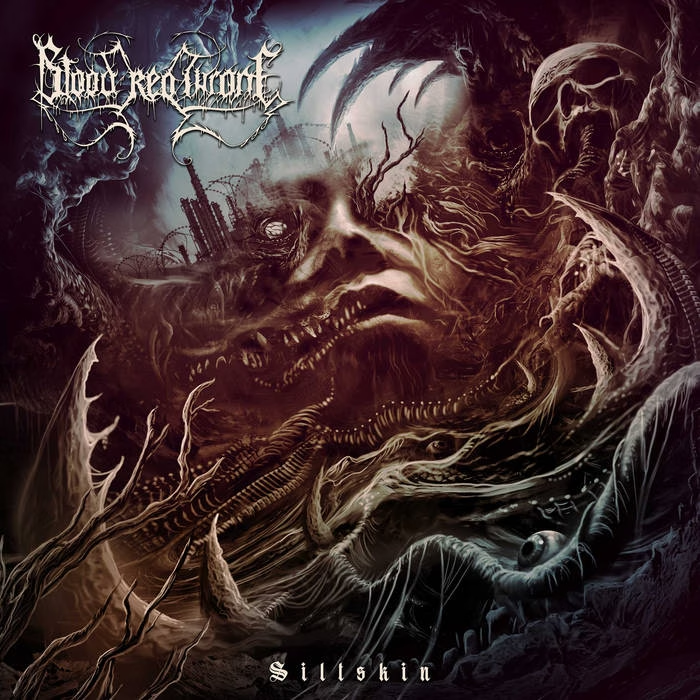
Blood Red Throne, one of the most acclaimed European death metal bands, released their 12th album, Slitskin, through Soulseller Records on December 5, 2025. The title means “cut skin,” and cuts and blood are two themes that are very present in death metal in general, and in Blood Red Throne’s death metal in particular.
Formed in 1998 in Kristiansand, Agder, Norway, the band was created by Daniel “Død” Olaisen and Terje “Tchort” Vik Schei, both former live members of Satyricon: Død was the live guitarist between 1996 and 1999, and Tchort the live bassist between 1997 and 1999. They also contributed to some tracks on Rebel Extravaganza.
Blood Red Throne stood out for their raw, aggressive and very well-executed sound. The focus has always been pure death metal, with cutting riffs, brutal vocals and extremely fast drumming. The current lineup features, on the deadly guitars, Død – the only remaining founding member – and Ivan “Meathook” Gujic, who joined in 2010; on the vibrant and very present bass, Stian Gundersen, in the band since 2018; on the insane drums, Freddy Bolsø, part of the original lineup, who entered the band in 1998, left in 2002 and returned to Blood Red Throne in 2013; and on the brutal, thunderous vocals, Sindre Wathne Johnsen, representing the band since 2023.
The death metal lesson from the incredible Blood Red Throne begins with nine new extreme, brutal and intense compositions.
“Scraping Out The Cartilage”
The first track on the album begins with a massive riff, and within seconds the devastation starts with their overwhelming death metal. It is marked by a fusion of modern brutality with an extremely heavy groove and an old-school death metal sound. It features deep gutturals contrasted with harsh screams, building a totally aggressive atmosphere. This is one of the most captivating songs on the album, both for its sound and for its violent and dark theme, evoking images of extreme, visceral violence – just as the title “Scraping Out The Cartilage” suggests.
“Beneath The Means”
Pure and straight to the point, without needing any kind of intro. Besides being fast, it is heavy on groove, and the presence of Stian Gundersen’s crushing bass is clearly felt. The guitars of Død and Meathook, together with Freddy Bolsø’s drums, manage to sound utterly brutal while still making any listener’s head bang. Sindre Johnsen’s vocals keep the same crushing register as a powerful contrast.
The song presents a social critique of hypocrisy, decay and the struggle of the class that lives “beneath the means,” as the title indicates – those below the established standards and those who hold power.
“Husk In The Grain”
Released as the first single from Slitskin on October 9, 2025, it starts with an excellent execution of sharp, dense riffs, just as death metal demands. It showcases intense blast beats, and the bass remains audible and heavy – something that doesn’t always happen in bands of this style – adding depth to the main riffs. Once again, the duality of the vocals, “low” and “dry,” creates a brutal atmosphere where everything aligns for a direct attack.
It tackles themes like physical and existential disintegration, visceral terror, bodily degradation, criticism of the human condition and the fragility of life, emptiness and abandonment, where identity dissolves.
It offers an almost poetic vision of physical and existential death. Strong, visceral images express a feeling of inevitability and dissolution.
“Necrolysis”
It begins with intense violence: a roar, then a full-on attack. Marked by tempo changes, it contains slower sections that are still subtly brutal, with a distinct slamming presence (focused on very heavy, rhythmic riffs).
There is a mix of deep growls with piercing screams. This combination of sounds creates a texture that complements the theme of decomposition – the voice itself seems as if it is being corrupted or corroded.
“Necrolysis” is a term derived from “necrosis” and refers to the breakdown and decomposition of dead tissue in the upper layer of the skin. The song paints a mental picture of dissolving flesh, disease and rot – the destruction of the body, in this case of the cells themselves.
“Anodyne Rust”
One of the shortest tracks on the album, it’s an ultra-fast burst with no distractions. The riffs are very dynamic and fluid, influenced by the old-school death metal style, but with a more modern and polished production. It acts as a peak of intensity in the middle of the album, keeping the aggression level high and using blast beats to create a relentless attack.
Blood Red Throne explores dark corners of the human condition, where hope is an illusion and the only comfort is destruction. “Anodyne” is something that soothes pain or suffering – superficial comfort, passive acceptance and an escape from reality. “Rust” is the slow, irreversible worsening. The song represents illusory comfort that masks ruin and destruction.
“Vestigial Remnants”
Organs, structures or traces that have become degenerated, atrophied or useless, along with leftovers and remains – this track addresses the degeneration of consciousness and society. Humanity can be seen as a “vestigial remnant” that has lost its function and evolutionary purpose and now merely exists.
Here the intensity starts to vary more. You can hear more melodic elements, alternating between extreme speed and slower, heavier, groove-laden riffs that emphasize the dark atmosphere and the feeling of something disintegrating.
“Vermicular Heritage”
Released as the second single from the annihilating Slitskin on November 21, 2025, exactly two weeks before the album release.
The past is something that lives within us, shaping our identity whether we want it or not. Flesh and earth are both marked by something ancient that never disappears, something hereditary that lodges itself in living matter. A gesture of resistance arises in vain – the desire to cleanse, tear out or purge this vermicular presence is intense, but even after trying to corrupt it, we realize the legacy returns, slithering through the emptiness left behind.
All of this is accompanied by the serpentine riffs of Død and Meathook, which rise and fall in undulating patterns, while Freddy Bolsø follows with well-placed blast beats and dragging grooves. Then comes Johnsen’s cavernous guttural attack, and you can feel the dehumanization.
“On These Bones”
Here, a great riff stands out, with a tremendous groove. There are sections that are purely rhythmic and crushing, clearly made for headbanging.
The theme is nihilistic and materialistic, rejecting the idea of life after death and declaring that the only legacy is the physical skeleton. Flesh and life are temporary and futile; in the end, only bone remains, like a cold, silent monument.
It conveys an aggressive rejection of any religious belief that promises something beyond the grave.
“Marrow Of The Earth”
The last track on the new album by the thunderous Blood Red Throne comes in with a massive sound, creating an extremely dense wall of sound, always accompanied by their characteristic groove.
The theme is based on essence – the deepest and most vital core substance of our world – using it as a metaphor to explore anti-religious ideas, individualism and the inherent truth of material existence. The “Marrow of the Earth” is seen as the fundamental force that nourishes individual freedom and the rejection of the “herd” mentality imposed by religious or governmental structures.
Thus ends the 12th album by Blood Red Throne.
Here lies the reason Blood Red Throne is one of the most acclaimed European death metal bands: intense, cutting, and distinguished by a groove-heavy style that can make any wall shake. It perfectly showcases the “new wave” of death metal while also knowing how to use the classic old-school death metal style.