



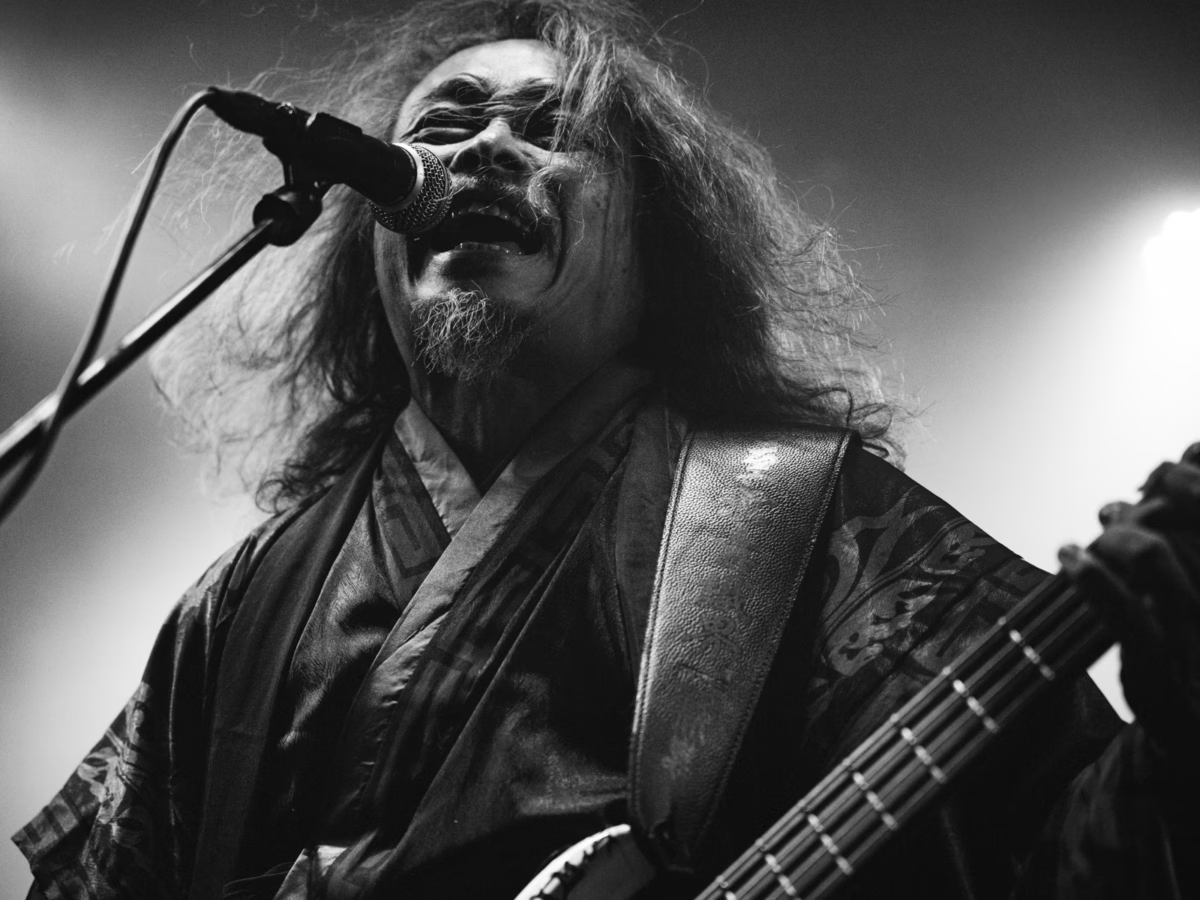
Sitting in the beer garden of the Dome, Tufnell Park, on a scorching summer’s day, I had the opportunity to speak with Mirai Kawashima from the legendary progressive black metal band Sigh. This was ahead of the band performing an incredible old school set of early Sigh material later that day, of which you can read the full review on MJB.
Relaxed despite the heat, and sporting a colourful Voivod shirt, Mirai was a real pleasure to chat with about his band’s forthcoming album Goh-Ka—their fourteenth no less!—which will be released through Peaceville Records on 4 September 2026.
The album’s key theme is ‘Kuso-zu’, a series of Buddhist paintings or illustrations depicting the nine stages of a human body’s decomposition after death, which the band describe as “created to encourage meditation on the impermanence of life, the inevitability of death, and the detachment from physical beauty and worldly attachment.”
And many of my questions relate to this idea, as well as the creation of Goh-Ka and the band’s next steps.
Read or watch our interview below:
Joe (MJB): Congratulations on the new album! I’ve been enjoying it so much and would like to talk about some of the concepts behind it. Could you tell us about your relationship with the idea of Kuso-zu and how you came to make that the basis of the new album?
Mirai: Kuso-zu is one of the traditional Buddhist paintings that shows how even a beautiful woman, when she dies, rots away in a very, very ugly way. So it’s the essence of Buddhism, which is: nothing lasts forever. You shouldn’t stick to anything. You have to let it go. That’s the Buddhist concept.
The theme of the album is some kind of continuation from the last one, Shiki. I’m 56 now, and death is getting more and more real. I’ve been writing about death from the very early stages, but when I was 20 or 30, death was something like a fantasy. Now it’s a harsh reality I have to face. I lost my father a few years ago, and some of my friends unfortunately passed away in recent years. Death is now a very, very realistic horror to me.
Death is a universal theme for all of us. Kuso-zu tells us that you shouldn’t cling even to your life, because we have to go sooner or later anyway. I can relate to it very much as I’m getting older. That’s the biggest inspiration for the album.
Joe (MJB): Is this an idea that a lot of people in Japan and other countries in that region would be familiar with?
Mirai: Kuso-zu was not very well known before, but now there’s a very, very popular manga called Jujutsu Kaisen. They used Kuso-zu in one of their episodes, so I think younger kids are familiar with it now.
Joe (MJB): Do you see it as a positive idea? Trying to say that, for most of life, you need to look at the things that are important—the deeper things—rather than aesthetics?
Mirai: Yes, of course. I think it is meant to be something positive, but it’s very hard to live like that. Everyone is basically afraid of death, and it’s not easy to get away from the fear of death, even if you try to be as positive as possible. I know the concept, but it’s not easy to live like that.
Joe (MJB): With Shiki [Sigh’s album from 2022), you were talking about the idea of Autumn. Maybe Goh-ka is your Winter album?
Mirai: Yeah, because now, if our fifties should be autumn, we have to get ourselves prepared for winter, which will come very soon. So, yeah, that’s true.
Joe (MJB): I wanted to ask about when you were composing the music for the album. When you started to think about the idea of Kuso-zu and began composing the music, did you sit down and think: right, here are certain scales, musical motifs or instruments that might help reflect that concept? Or was it more organic?
Mirai: I think both. Sometimes it’s very organic. Sometimes I have to use musical theory, like scales and chord progressions and things. But with Shiki and this album, it has been getting more and more organic somehow.
Joe (MJB): You’ve got some wonderful artwork for the album. I know you’ve stated that the songs on the album and the artwork are examples of Kuso-zu. Were you surrounding yourself with pictures and poetry connected with this concept? Were there particular texts and images—particular versions of the story—that you drew from?
Mirai: Some of the old ones are great, but there are some great Kuso-zu even from today. One of the best artists is called Fuyuko Matsui. She made a very, very beautiful modern Kuso-zu with a much more modernized touch. I love some of them too.
Joe (MJB): You’ve got guest musicians on the album, including some regular collaborators like Mike Heller.
Mirai: I’ve been working with him since Shiki, and we did Hangman’s Hymn and recorded with him too. He’s a crazy drummer, and he understands our concept very well. We want some very, very extreme drumming. I don’t have to tell him a lot of things, because he can easily get what I mean. I think we’ll keep working with him. He’s a great drummer and a crazy drummer at the same time. He’s the ideal drummer for Sigh, I guess.
Joe (MJB): Fantastic. And obviously Mikael Åkerfeldt as well. How did that collaboration come about?
Mirai: That was pretty much organic. When I was thinking about what to do for the guitar solo on the song called ‘Unputenpu,’ I happened to get an email from Mikael. Then I thought it would be a good idea to ask him to do that. I emailed him, and he was kind enough to respond very quickly. He was interested, so I sent him the track and he did a really great job on it. It wasn’t planned; it happened very, very naturally.
Joe (MJB): He absolutely shreds on that track. He has a reputation as a guy with a great sense of humour. What was your experience of working with him? I imagine you had a good time.
Mirai: He’s a musical maniac. He knows a lot about music, and he loves avant-garde too. I think we have a lot of musical tastes in common, so it wasn’t very difficult for him to do the guitar solo for that song. I didn’t tell him anything, but he quickly understood what I wanted. It was awesome.
Joe (MJB): What about some of the other instrumentation on the album, such as the more traditional instruments? Were there any particular new instruments that you haven’t used on a Sigh album before?
Mirai: Probably the shamisen. Shamisen is a traditional Japanese acoustic-guitar-like instrument.
Interviewer: That has just three strings, right?
Mirai: Yes, just three strings. We used it a little bit on Shiki too, but this time we featured shamisen a lot. Dr Mikannibal has been taking shamisen lessons for a long time, so she played the shamisen. Her teacher was kind enough to play some technical shamisen parts for two of the songs. I think that’s one of the new things on the album.
Joe (MJB): There’s also a particular drum sound on there. Are they taiko drums?
Mirai: It’s very hard to tell, because Mike Heller layered maybe 20 or 30 small percussion instruments too. Also, Sota Asano is a traditional Japanese drum player, so he played some Japanese—so-called taiko—traditional taiko on some of the tracks. There are plenty of percussion instruments from all over the world. Mike Heller even played some—I don’t know—trash cans, and of course traditional bongos, congas and everything. So there are plenty of percussions from all over the world [on the album].
Joe (MJB): It feels like the most orchestral album so far. Obviously, you’ve been using orchestral sounds for a long time, but there’s something about the production on Shiki and the latest album that feels like the grandest, most cinematic version of the whole vision. It sounds so detailed.
Mirai: Yeah, I guess so. Before Shiki, intentionally, I didn’t use any orchestral stuff at all, because I was a bit fed up with it after we did an album called Graveward. I used a lot of orchestration and didn’t like it very much. After that, I tried not to use typical orchestration.
But after Shiki, we re-recorded Hangman’s Hymn — I Saw the World’s End and I did a lot of orchestration again. I think it affected Goh-ka a bit. This time I used flute, trumpet and that kind of stuff, so it’s just a little more eclectic than Shiki. I used a lot of Japanese percussion instruments along with Western orchestral instruments. I think it’s a more cinematic album, especially compared with Shiki.
Joe (MJB): That was my experience as well. I also wanted to ask about the album reissues that have been coming out recently. [Peaceville Records have been steadily re-releasing early Sigh albums which were previously difficult to acquire.] That process is still ongoing. What has it been like to revisit your old material? What’s your involvement in the reissue process?
Mirai: So many labels tried to re-release it over the past 20 years, but none of them worked because, honestly, Cacophonous Records is a very, very difficult label to work with. But finally Peaceville succeeded in releasing everything, last year and this year. Finally! I’m glad. So many people asked us about the possibility of reissues on vinyl and everything, but finally we made it.
Also, Infidel Art had some unreleased mixes and some demo versions and everything, so I had to go into my old CD-Rs and cassette stuff. Those albums are primitive and childish, of course, compared with today’s records, but still I think some of them sound really good to me.
Joe (MJB): Oh, yeah, for sure. I’m very much looking forward to hearing some of that material tonight. What is it like listening to those old albums again? Are you thinking, “There are things I would change…”?
Mirai: Of course. Infidel Art and Ghastly Funeral Theatre, those albums, we recorded them almost 30 years ago. Now I’ve grown up as a musician, and I’ve grown up as a person too. Of course, the composition, orchestration, lyrics — everything is immature to my ears today. But that immaturity can be charming in a way.
Of course, if we re-recorded them today, we could play much better and the production could be much better. But it could spoil the charm of the albums, so I wouldn’t do that. I wouldn’t re-record Infidel Art or Hail Horror Hail. Personally, I think it’s better to leave them as they are. Of course, I can hear a lot of defects and mistakes and all those things, but it’s okay. I like them as they are.
Joe (MJB): What’s it like bringing them back on the road and playing them live?
Mirai: It brings back a lot of memories of when I was younger. Last night, the show was really good, and the reaction was really good too. I think it’s a good idea to do this kind of special early, old-school set as a trio sometimes. Hopefully we can do it again sometime.
Joe (MJB): We’re very much looking forward to it. Have you played Goh-ka live yet? You’re going to be in the U.S., and then you’re going to Europe later in the year. Will that be the first time you play Goh-ka on the road?
Mirai: We will not play anything from Goh-ka in the U.S. because it’s before the release, and we have a lot of stuff to play. We have 12 albums so far, or something. But we will play some from Goh-ka in September in Europe. It’s going to be the tour to support the new album, so we’ll play some tracks.
Joe (MJB): One final question. Sigh celebrated 35 years recently. You’ve achieved so much. Like we were saying, there’s the complexity and ambition of the albums. I feel like with every release, your ideas develop and it feels like the next step in the development of Sigh. You’ve achieved so much — are there other things you still want to achieve with the band in any way?
Mirai: Well, actually, no. Even when we started the band in 1990, we were not ambitious at all. We never thought we would be able to release an album, because around 1990 no Japanese extreme-metal band had international releases at all. I just thought it would be great if we could release a seven-inch EP or something. Just releasing an album was an achievement I didn’t even expect.
In that sense, we’ve been doing much more than our first expectations. I don’t have anything that hasn’t been achieved yet. I never thought we would play at the big European festivals. We got to know a lot of bands that I had admired when I was younger. Everything is way more than my expectations, so there’s nothing I haven’t achieved.