


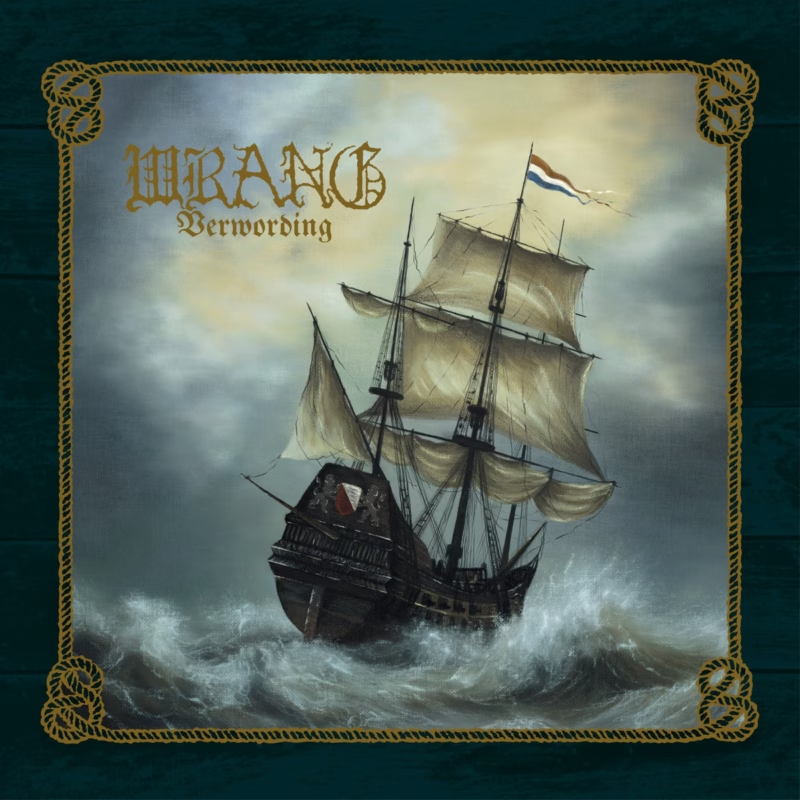
Wrang, a defining act of the Dutch black metal scene, are a distinctly bitter force. Formed in Utrecht in 2013, they have been active since 2015. Galgenvot (vocals and guitars) and Valr (drums) remain the only two permanent members, though they recruit three additional musicians—two guitarists and a bassist—for live performances. On stage, Galgenvot sets his guitar aside to focus entirely on his harsh, commanding vocal delivery.
The word “wrang” carries significant semantic weight in Dutch—translating to bitter, sour, or cruel. I see this as the guiding line of the band; their themes revolve around human decay, the futility of existence, and the denial of logic and morality. Across three studio albums, one EP, and one split, Wrang reject the excessive polish of modern metal. Instead, they focus on a visceral, abrasive sound that I read as a manifesto of nihilism.
Widely respected in the European circuit for their live performances, Wrang operate as the antithesis of theatrical spectacle. They bring a confrontational, unembellished energy to the stage. I notice a visible physical intensity in their shows; they avoid long pauses or audience interaction, choosing instead to unleash a wall of cynical, aggressive sound. Consequently, they are a regular presence at festivals that favor purist, underground black metal.
Verwording: A Nihilistic Manifesto
On April 24, they released their third studio album, Verwording, through Dominance of Darkness Records. Across its six tracks, a fusion of aggression and melody dominates. While I hear early inspirations leaning toward bands like Horna, Taake, and Slavia, their recent work—especially their 2022 second album, De Vaendrig—presents a black metal style heavily indebted to black ‘n’ roll.
Verwording—a title that translates to degeneration, decay, or deformation—perfectly summarizes the band’s aesthetic. Driven by sharp, triumphant guitar work and a feverishly urgent execution, I find the album to be a forceful journey through dark, emotionally fraught corridors. It presents an old-school-inspired black metal: atmospheric, raw, and relentlessly aggressive.
Track-by-Track Breakdown
‘Stilstand’
I look first at the opening track, ‘Stilstand’, which addresses themes of stagnation. It examines the state of a society or an individual stuck in motionless time—where nothing new grows and old mistakes perpetually repeat. The track begins with a sense of paralysis. I hear a tense composition that alternates between furious blast beats and slower, suffocating passages. Wrang employ circular song structures, giving me the impression that the music constantly tries to break free, only to return to the same point of aggression.
‘Entartete Kunst’
Following the initial outburst, the album transitions into ‘Entartete Kunst’ (Degenerate Art). This title carries significant historical weight that fits perfectly into Wrang’s confrontational aesthetic. The Nazi regime originally coined this term in the 1930s to describe and ban modern art that failed to conform to their ideals of perfection and purity.
In the context of Wrang and black metal, ‘Entartete Kunst’ functions as a form of self-identification. The band assume the role of the degenerate artist. They position black metal as the exact art that a modern, polished, and “correct” society tries to hide. I interpret the track as a critique of a culture afraid of dissonance, darkness, and true individual expression; it defends art that wounds, disturbs, and refuses to apologize for its existence. Sonically, the band utilize frequent tempo changes and non-traditional harmonies, mirroring the rule-breaking nature of forbidden avant-garde movements. Galgenvot and the band deliver a dirty distortion alongside vocals that verge on madness, representing creative liberation through sonic violence. To me, it is the cry of an artist refusing to remain still and silent amidst the decay of modern culture.
‘Nachten in Wahlheim’
The third track focuses heavily on atmosphere. I consider it the most melancholic piece on the record, evoking the loneliness of nights in the isolated village of Wahlheim. By combining “nights” with the setting of Goethe’s The Sorrows of Young Werther, the band center on desperate vigilance. The listener isn’t just visiting Wahlheim; they are trapped there in the dark, where nature offers no comfort—only silence and paralysis. Valr’s drums sound as if they echo through an empty valley, heavily reinforcing the idea of isolation. Galgenvot‘s guitar work here is melodic, yet sad and cold. He plays longer, repetitive riffs that deliberately induce a hypnotic trance. The song intentionally refuses to move forward, honoring the album’s overarching theme.
‘Voor uns de Zee’
Marking the second half of the album and the start of side B on the vinyl, ‘Voor uns de Zee’ stands out as one of the most evocative and raw pieces on Verwording. The track uses the image of the ocean not as an escape route, but as an impassable wall. I feel it perfectly describes reaching the edge of the known world and realizing there is nowhere left to go—the exact point where unrestrained greed meets its physical limit.
Musically, the track relies on a dynamic push and pull to simulate the movement of tides. The guitars feature sharp riffs that flow through the mind like ocean waves. Wrang momentarily abandon their dry, urban tone to adopt fluid melodies, though these remain heavily charged with a cutting melancholy. They deliver a salty, rough iteration of black metal; the drums maintain a constant, hypnotic pulse reminiscent of waves crashing against rocks. Instead of chaotic disorder, the band harness a rhythmic, persistent violence. ‘Voor uns de Zee’ represents the final obstacle—the sea prevents any forward motion, acting as the boundary where movement ends and contemplation of the abyss begins.
‘De Duivel is de Ander’
I then move to the penultimate track, ‘De Duivel is de Ander’. ‘The Devil is the Other’ serves as one of the strongest and most philosophically dense statements on the album. The title clearly subverts Jean-Paul Sartre’s famous phrase—”L’enfer, c’est les autres” (hell is other people)—adapting it to Wrang’s bitter, nihilistic aesthetic. The track explores the human tendency to project evil, failure, and blame onto others instead of looking inward. The band suggest we create demons in other people to justify our own hatred or isolation, implying that true torment stems not from supernatural entities, but from our forced coexistence with humanity.
Sonically, the track delivers a misanthropic attack. The guitars carry an acidic tone, snarling directly at the listener. Wrang abandon the atmospheric subtleties of the previous track to focus on purist black metal injected with a touch of black ‘n’ roll. Galgenvot’s performance sounds particularly disgusted; he spits out the lyrics with an intense, aggressive cadence. The track rarely slows down, perfectly symbolizing the constant conflict between human beings.
‘Bijtebau’
‘Bijtebau’, the sixth and final track, stands as the longest piece on the album. Clocking in at nearly ten minutes, I view this epic closer as a progressive journey within black metal, traveling through various states of mind—from absolute despair to a grand, desolate finale. It leaves me with a sense of final emptiness, representing perhaps the most dense and suffocating moment in Wrang’s entire discography.
The song emerges with a solitary, melodic guitar accompanied by noises evoking seabirds, mimicking the sensation of finally reaching land. The band blend atmospheric elements with guitars that create melting, deteriorating harmonies. I hear no triumph here, only the persistence of a sound that actively refuses to offer hope. Galgenvot delivers what I consider his most exhausted performance; rather than a scream of hatred, he lets out the lament of someone who accepts that the end has finally arrived.
Final Verdict
Ultimately, I see Verwording as Wrang’s definitive manifesto on the paralysis of the human condition. While the band explored logic and nihilism in previous works, here they descend into a state of absolute stagnation. The record traces a narrative arc moving from desire directly to defeat. It begins with the greed that drives us, passes through the rejection of culture and morality, confronts our isolation and hatred of others, and ultimately ends at our physical and mental limits.
Wrang confirm they are masters of the bitter aesthetic. When the record stops spinning, only the silence of ‘Bijtebau’ remains—alongside my lingering feeling that, in the end, we all arrive at our own degeneration.