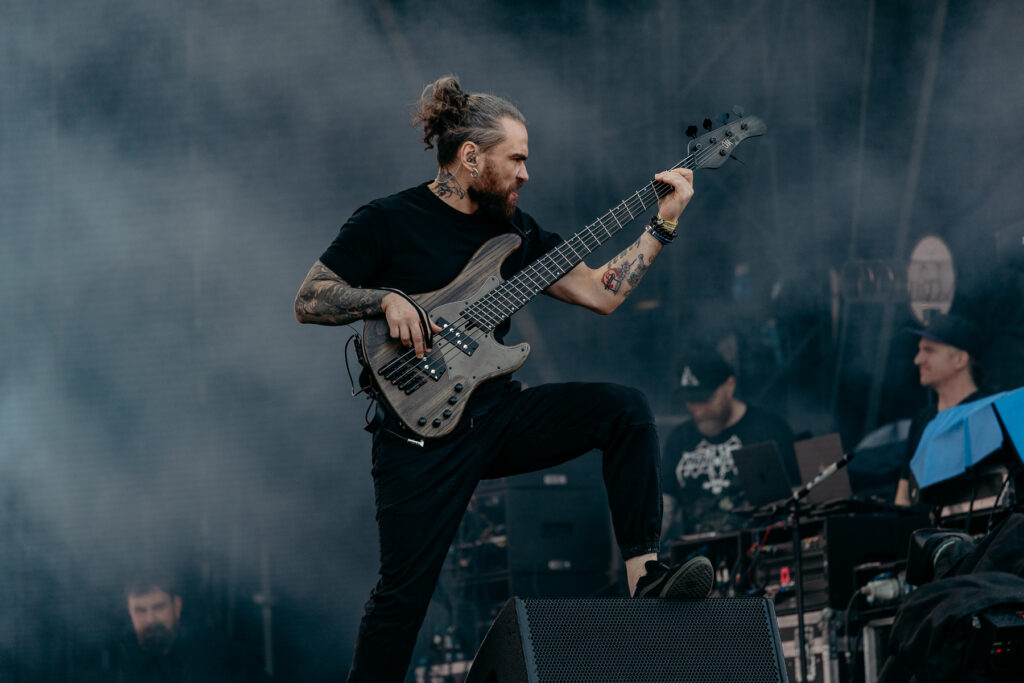
“Well-performed music at a certain level of volume makes people move,” is the quote that stuck out the most to me from my conversation with Eugene Abdukhanov, bass player and long-time member of Ukrainian metalcore band Jinjer. After a 3-year hiatus from touring, the quartet is back with a relentless schedule across the States and Europe, including a stop at O2 Forum Kentish Town on January 31st 2026. If you’ve never experienced the stampede of sound that is their live set, you’ve yet to learn to move. Metal shows are many things, but how people display their enjoyment can vary.
Sometimes I focus on particular people. There are two ways. Either people really enjoy it and show it with everything possible, or there are people who just stand there still, like a piece of a stone. That is also a person to watch; I’d look for eye contact with such a person and then I try to provoke them like “Come on, doesn’t it move you? Just start nodding, man.” And eventually, if I make them move, then it’s a big win.
How anyone can stay still to a Jinjer set is beyond me. Eugene sure can’t. “Over the last 15 years, I think it won’t be an exaggeration to say that I spent most of the time on the road. I am used to it and also kind of addicted to it; it’s a big part of my life. No matter how much I enjoy being at home with my family, music is another dimension of me, and I cannot go without it.“
It came as a surprise to me that he came to playing music later in life. “It’s a trivial story,” he said, yet I think that for anyone born in Eastern Europe, where heavy metal is often a boogeyman shoved away from the mainstream, reaching the sort of stages Jinjer has makes their story not only noteworthy but also aspirational.
“I started quite late. I am from a very average labour-class family, and I don’t have any musical background. Neither of my parents has any musical background, and music wasn’t even played much at home. But somehow, I got into music quite early because of friends who would supply me with records. When I was 18 years old, I made some new friends who were in a band. I was already a big metal fan, and at some point, I just thought like, Why not try and play something? I thought that the bass guitar was going to be the easiest because it has only four strings. So, I was wrong.”
His first bass guitar gave him a hard time. “In university, during winter holidays, I had an opportunity to go to a different city and work in construction and make some money, and I bought my first bass guitar. It was an old Soviet-made bass guitar, and everybody coming from this part of the world knows what it is. It is called Ural, and it’s horrible; it’s a horrible instrument. But a lot of good musicians from Eastern Europe started their careers on this kind of instrument.”
It was enough to get him the gig of a lifetime.

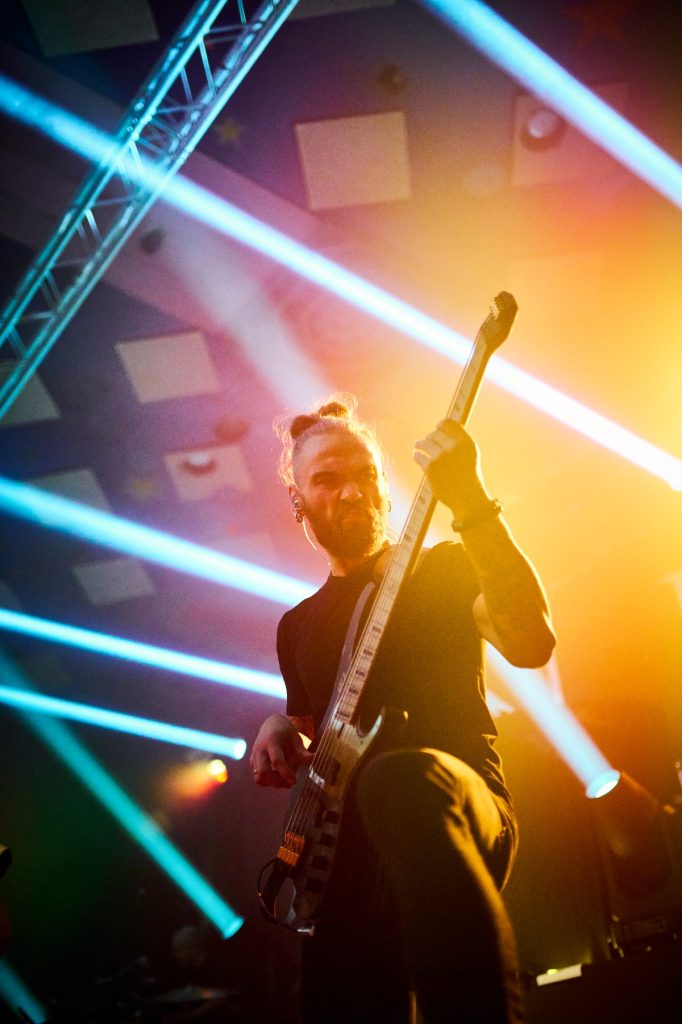
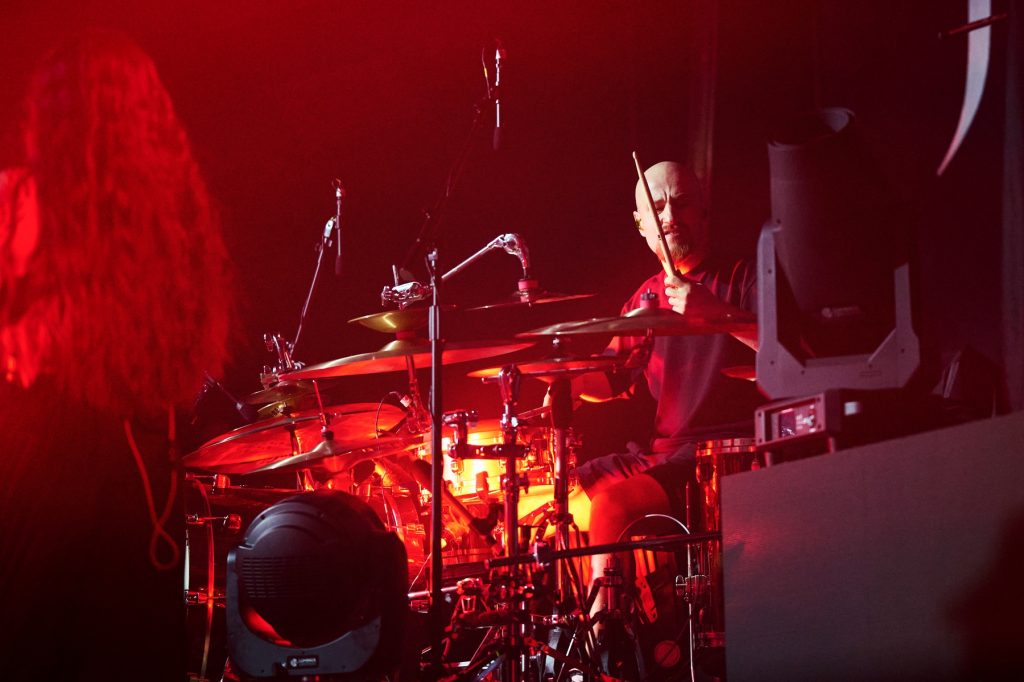
“Jinjer happened to me much later. We became friends in 2010. I used to play in a different band; we shared some gigs, stages, and some parties, and in 2011, they needed a new bass guitarist, and I was just there. We were all more or less the same level of musicians when I joined the band: some more talented, some just very hard working, as I am. I’m not I do not consider myself to be a talented musician. Everything I play is just a matter of hours of practice. Nowadays, we play sophisticated, sometimes technically complicated things, in a mix of genres. But our first record, the EP we released back in 2012, ‘Inhale, Do Not Breathe’, wasn’t so complicated. Over the years, we evolved as musicians, and the music evolved with us.”
A city like London can easily have 150 shows playing every night in every conceivable genre, from Wembley Stadium to the smallest pub stage. Choice is abundant in the West. “It’s common for all post-Soviet countries; everything connected with heavy music is very underground. We didn’t have infrastructure, venues to play. But still, it worked. There were bands, there were some places to play, but gigs were not so common, maybe a couple of gigs every two, three months.”
The place we come from, Donbas, it is an agglomeration of cities, very densely populated. Donetsk used to have slightly more than a million people and I was from a city called Makiivka, right next of it, of half a million people. Even the city where Jinjer originally comes from, Horlivka, 30 or 40 km away from Donetsk, it used to be 270,000 people. These are the biggest cities right next to each other and that’s why there was there was some sort of an underground scene.

On 7th February 2025, Jinjer released their fifth studio album, Duél. “Tatiana was really into the 19th century while writing the lyrics and finding the concept for the album. Everybody understands that the 19th century was quite different from our time because now the lingua franca is English, but it used to be French. That’s why it’s called lingua franca. All the nobility across Europe spoke French, and that’s why a lot of literature and art is greatly influenced by French culture or made in France. It’s impossible to study the culture of the 19th century separated from all other elements of society. The society itself, the economy, ideological trends, and philosophical trends must be studied all together, combined.”
I keep hearing this very often, people say that history is nonsense and nobody needs it. It’s wrong because once you know history, you understand what might happen in the future. Everything in history spins. It keeps spinning and keeps returning and repeating itself.
Unlike all previous albums, for Duél, they had the advantage of time. “We had a very long time to make it. Vlad [Ulasevych] started writing songs for this record even before Wallflowers was released. I remember I recorded the first bass demo for “Someone’s Daughter” in 2022. On my side, I changed arrangements quite often. It’s why I’m saying this is the most well-thought-out album. For the first time, we actually had vocals recorded for the pre-production before we went to the studio to make the final record. We already knew how the songs would sound. Everything else we did before, we never knew what the vocals would be, and we only got to know it for the first time when Tatiana entered the booth to record her voice. In many ways, everything she recorded before Duél was improvisation. A good example is “Captain Clock” from King of Everything. The final part of that song is the first take she made. We had a couple of months to listen to it, make some changes, usually to make the lyrics fit and make it logical, reasonable. And Tatiana had the chance to make changes too, choose what she likes and which parts to change.”
Vocals and lyrics come after music. Over the years, as we were evolving as musicians, we started to be more thoughtful about our music. And our approach is that the music itself tells a story. Even without vocals, our music is self-sufficient. There is a plot, a musical plot in every composition. We create the vibe, the atmosphere by music and then Tatiana listens to it and creates the lyrical component.
“We do not jam; we just send each other sketches, and if everyone approves, we start working on arrangements, changing this part or that part. For example, “Green Serpent” from Duél. I originally had it very different, and Vlad changed it at least 50 percent. He changed the riff for the verse, added a lot of riffs himself, the breakdown, then I added the final bass part at the end to complement the culmination. It is my favourite from Duél and “Kafka” is probably second or third place. Tatiana was greatly influenced by Kafka’s works at that time, and it is, to some extent, a resumé of his life and all the ideas he put into his works. The music itself is a journey. There is a main melodic theme, which goes along with the soft part of the song. The original bass melody was Vlad’s idea; he’d built the song around it as the main theme, and I didn’t argue with him. The bass work there is something I’m really proud of. I just tried to keep the vibe and build up the crescendo, the development that finalises itself in the heavy part of the song. It’s a big thing to play live. Both hard, but very, very fun to play.”
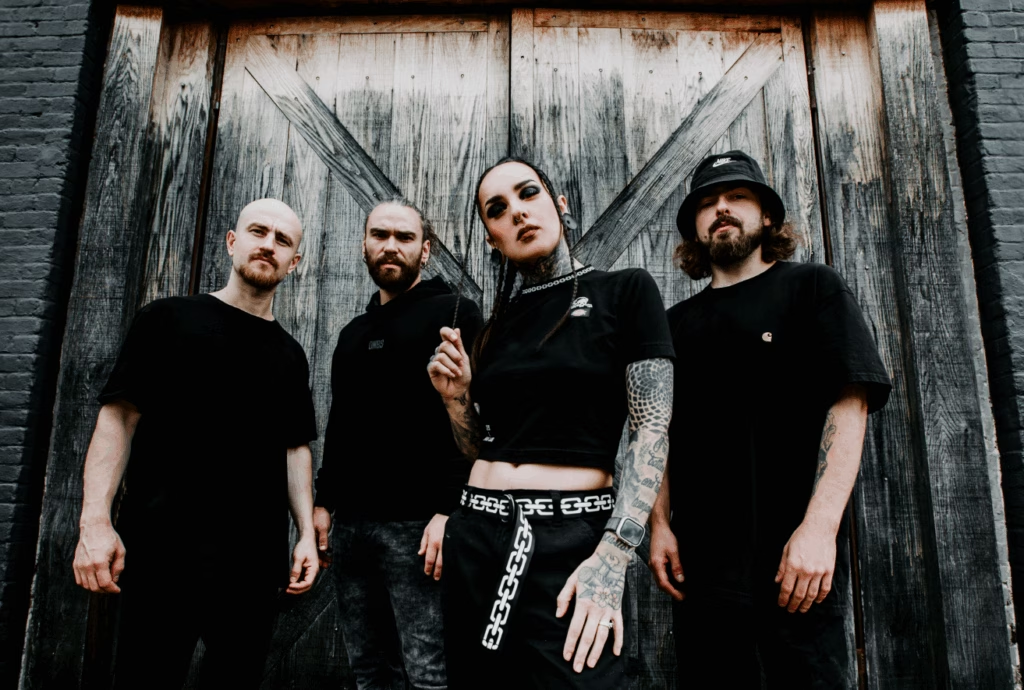
It’s a description that perfectly matches their appearance at this year’s Hellfest. “A couple of days ago, I watched our Hellfest performance for the first time in its entirety and felt really proud. We played well, and it looked fantastic. We headlined that stage that night, and it’s one of those shows, one of those life performances. It was insanely hot and insanely hard to play.”
It’s important to remember that now we speak English, and in English, we use the same verb “play” for music and for everything else which you enjoy doing. You play games, you play with toys, and you play music.
The main thing behind it is that it’s fun. It’s cool to see when people get the vibe. What I noticed is that once I enjoy it, they also enjoy it. Because if I enjoy it, then it’s being performed well.
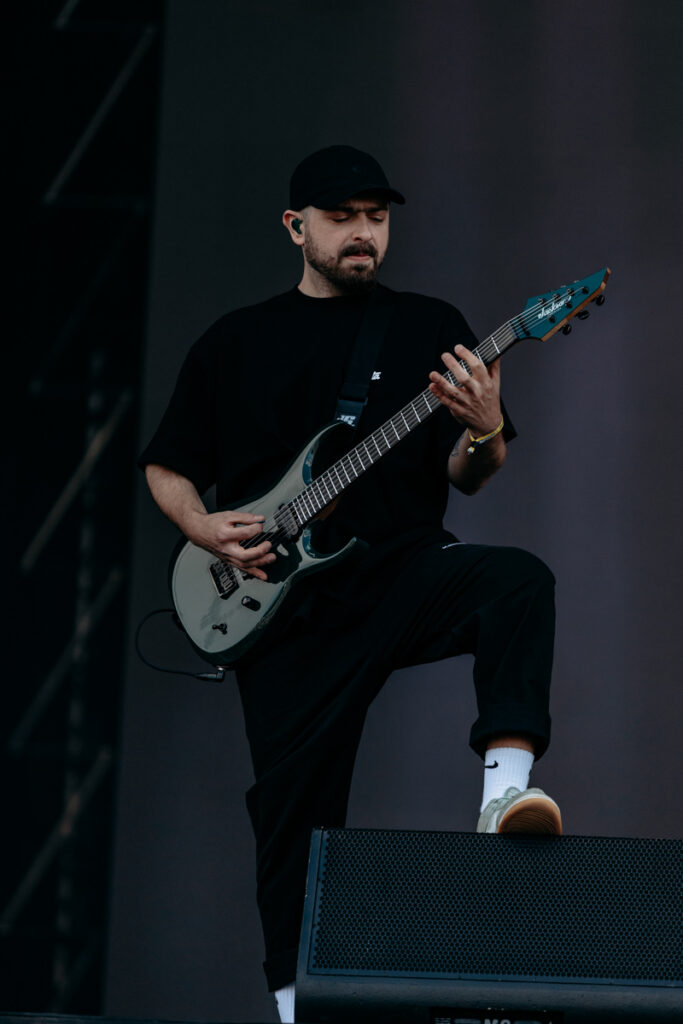

Regarding their upcoming London date, “I am so much looking forward to this. I love London as a city. It feels different; it’s one of those capitals of the world. We haven’t played our headline shows in Europe and the UK for so long, so it’s going to be very special and super fun.” MJB is running a giveaway for two tickets over on our Instagram page. To check it out, click here for more details.

As a bonus question, we asked about their tour Down Under. “We once played Good Things festival [in 2022] and I got to know that they close the bars right before the festival’s over, so as not to let people go and fight there. But at the same time, we once were going to a beach by Uber, and I asked the driver like, “Are there any areas in Sydney where it’s probably not a good idea to go?” And he just started laughing at me. He told me, “What problems might you have? Like fighting a kangaroo?” This is what he assured me. “Everywhere is safe.”
Tour life can take its toll, but the travelling aspect never gets old. “I just learned that it is important to enjoy every opportunity you have. So, once we have a day off everywhere, in Europe or in the States, we either look for something to do together as a crew, or when everybody is at a loose end and doesn’t want to do anything, I’ll just head out. I really love aviation museums. I’m a bit of a plane nerd.”
“Seeing old and interesting aeroplanes is great fun for me. Why is every museum different and special in its own way? Because most of them have at least one plane that is only there, nowhere else. A good example is the aviation museum here in Burgas, Bulgaria, next to the airport. You don’t really see an old Tupolev Tu-154 airliner open for the public to go inside and check everything inside. So I can find something interesting almost everywhere.”
Many thanks again to Eugene for his generosity and storytelling!