



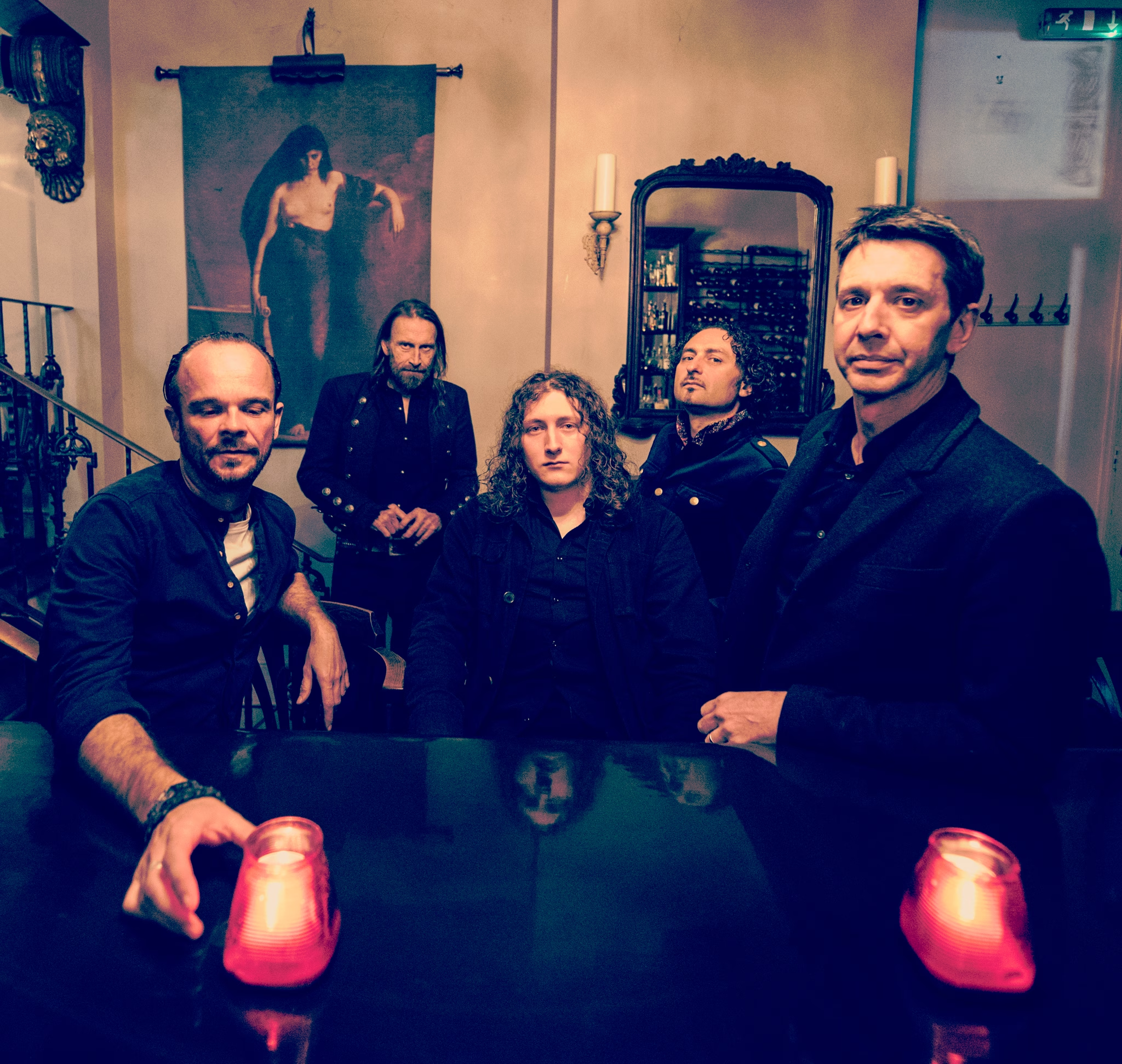
Pearl Handled Revolver know how to unpack big emotions. Their live show at the Camden Club was the perfect send off to summer and the out-of-body surreal happiness of a London drenched in sun. We got to catch up right before that show, as the anticipation set the room abuzz, and dig into their latest album, Tales you Lose, a surprising reflection of the pandemic and the confusing, enraging, strange times of 2020-2022.
Chris Thatcher (drums): We started right in lockdown. The first thing we talked about was writing really tight, short songs. It was hard, to keep going mentally.
Simon Rinaldo (keyboard): We were doing funny little Zoom things, just to be connected. We actually played two shows in the two weeks between coming out of lockdown and going back in. We were one of the few bands to perform and I’m very grateful we were. People were socially distanced and they were so glad to see live music. A lady bought us a bottle of whiskey and just left it on the stage. There were people crying in the audience. We couldn’t believe it, that people were so desperate to see bands.
Lee Vernon (vocals): Perfect environment for writing, though. You end up with a whole world that knows exactly what you’re talking about. You don’t have to be direct and I like to be a little obscure and let people find out what you mean, which you only really find out when you come and see us live. But hopefully that comes across on the album. Most of the album has elements of how different people were feeling at the time. A little bit of anger in there. A lot of forgiveness. The music kind of changes the mode of the lyric and this is why I love this band: I can pull out a poem if I feel that the music they’re creating is that feel, and before we’ve finished the evening, we’ve got half a song. It’s wonderful for a writer because you get to use your poems that would otherwise just sit in a book and wait around.
Their latest lineup includes Lucas Rinaldo on bass, an addition that brought a shot of fresh energy to the band.
Simon: On Tales You Lose, we wanted bass and some extra things. Lucas is my son and he’s a very proficient player and producer, so we got him in and he’s turned us into a really good band.
Lee: And reduced the average age of the band considerably, which is very nice. We all feel younger, which is never a bad thing, is it? But he’s changed the dynamic of the band to a degree that I think we’ve become more close to what we imagined we want to be. You’re always imagining you’re going to be a little bit better than you were last year. We’re able now to do much more with our creativity because of what he’s brought to the table. I think it’s freed us all, certainly Simon, he was juggling lots of plates at once: pedal bass, three keyboards, we don’t know what else he was doing under there. And Lucas knows everything about our history and the music itself. He grew up with it, so you can’t find a better bass player than that, really.
Chris: It’s definitely loosened things up a lot, the interplay is just better now. When we’re playing live, we can jam a lot more and a lot more easily. With the writing as well, none of us are sort of second guessing it at this point. We’ve played together for a long time and know each other inside out. And when you know your own sort of ticks and whistles, you can get to a point where you can start repeating yourself. But having Lucas in, it just gives it an edge ’cause it’s new.
Lucas (bass): I’ve sort of had a bit of a head start. If I’d have joined a band previously, you’d have to do all that hard work of having enough fans to do gigs and put on shows, so it’s always been a great opportunity. I was a bit of a bass player before I joined and now I feel like it’s my main instrument. That’s where you really find out whether you’re actually capable: when playing with other people.
There is an old-school robustness to the quintet, from the keen attention with which they watch each other perform on stage to their cohesive album themes.
Chris: Every time we’ve done an album, we’ve written it as a piece. When we’re writing the albums, as the track list is building up, we start thinking about the sequencing, that ebb and flow all the way through, so that it feels like a journey. With this album, there’s themes, there’s defiance. It starts off quite introspective, and then it becomes far more angry, but defiant anger rather than just rage. It’s capturing a moment in time. That’s another thing from jazz, people didn’t even like the fact they were making records ’cause it was supposed to be in the moment.
Lucas: I think the people who listen to us like full albums, because they’re always thinking, “Oh, is this one going to come out on vinyl?” Yes, because we know that you love it. I think a lot of the people who are into the band, they really like the actual physical thing there.
There were a few songs I wanted to dig into, starting with the album’s first track.
Simon: “Black Rock” was the last song we recorded and it was a jam. Lucas and I had a chat, “Let’s set the mics up. Let’s get everything ready so that this session could be a recording. And if it’s good, good. If it’s not, we’ll delay it another month.” I just had a feeling that it was going to be that session. We played [the song] through and it felt great. The structure is what we did on the day, which is why it’s 10 and a half minutes long. There’s a section where Chris and I worked off each other and played out of time with each other, in polyrhythm. We were just half listening to each other.
Chris: Half listening – polyrhythmically.
There is an almost storytelling quality to the song, with Lee’s vocals speaking as if from high above. It turned out this was a very conscious decision.
Lee: I try to write as if I’m looking in on my life or the life of the person that I am writing about. It’s always an attempt to distance myself and try and see something else that might be there. I find it most interesting with other people’s lyrics where there’s an air that they’re not writing about themselves per se. I’ve got this self-conscious thing that I don’t want to directly write about me, and I think this is quite correct, because when you do, you generally sound a bit pathetic. It seems insular and I don’t think anybody else can really engage. By being a bit more ambiguous and looking for different ways to express my own feelings, which I don’t know I’m doing at the time, and about 3 months later, I go, “Oh shit, that’s why I wrote that. I see why I wrote that now.” By writing in that distant sense, I enable something to come out of me.
This feeling of a being high above the ground, overseeing all that goes felt particularly fitting to the lockdown era.
Lee: That’s how COVID felt, that we were not present, but we were watching it happen. We were trying to work out how to talk about that without the poking, and “it was your fault” and all those things. With “Black Rock” being the last song, I was able to look at everything we’d done before, and then bring it together with that song, which we can never do till the end. We do plan the album, but I don’t think we really know until that last song where it’s going to go. That randomness in the lyrics is magical to me sometimes, ’cause I go, “Oh, actually, they relate” and I hadn’t put that together even myself sometimes.
I had to delve into my personal favourite off the record, Courageous, an incredible lesson in restrain and release, in holding off the payback for a buildup until the last possible moment.
Chris: That was a jam too. I love that you picked up on the extremes, ’cause I think I put an Instagram reel out and the title was, “practicing with wild extremes tonight“. We first had it really low, like a Miles Davis sort of On the Corner thing, all sort of side sticks and stuff. Then we came back and played it really loud. We were like, “Well, we should try and flip between the two.” So we spent most of one evening just practicing that transition, going up and then trying to snap it straight back down. When [Lee] started singing those lyrics, it was exactly like, “No, don’t go yet. He hasn’t finished. Don’t go yet. Don’t finish.” And it just holds and holds and holds and holds.
Simon: We wouldn’t ever say we’re a jazz band. We can’t be. But there are elements. I think Chris and Lucas and I really like Miles [Davis] and that 70s era where people like Chick Corea really influenced me with my chord patterns. I just make it up as I go along, to be honest. That’s jazz. There’s never a wrong note. It’s improvisation.
Simon: The first song we wrote for the album was “Gilding the Lily.” We’ve been performing it as a four-piece for at least two years. It took me two years before I even presented it to the band.
Lucas: It’s probably about six or seven years old.
Simon: I had a completely different plan for that song. It was more of a Mahavishnu Orchestra kind of vibe. And I was channelling my Jan Hammer on the Fender Rhodes. And it wasn’t until Lee came back (he was out of action for a little while) that the song actually happened. It proves that unless we’re all together, we can’t do it.
Do they jam on stage?
Chris: A lot of songs have long jams.
Simon: You’ll enjoy it tonight.
Chris: Some of them are structured, but, and some of them are very loosely structured. We do go on a bit.
Simon: And that is something that stems back to when Lee and I were in a band together called Blunderherd, it’s where I learned the art of jamming. We used to play a lot of dub style and funk.
Lee: We could play for an hour and a half and didn’t know what we were doing, did we?
Andy Paris (guitar): There’s a few songs on this album that we were trying out in sets. Sometimes you can get into a rut of like, “We need to get this song time, put a time constraint,” and we didn’t really do that this time. We wanted to air them, and when we knew that they were kind of where we needed them to be, that’s when we hit the record button.
While three songs on the album stretch way past the 10 minute mark, it is a collection of shorter pieces, as they had initially set out for it to be.
Lee: Certain songs demand punchiness. They want to hit you between the eyes and then go away quickly. And Hammer was one of those.
Chris: That was from that early part of the album, when we talked about writing a set of short songs, and that’s less than 3 minutes. I love that about it, it’s condensing it all, not letting it outstay its welcome.
Lee: But there’s more words in that than there are in any of the other songs. I was reflecting on how philosophical trends have changed and what we value, society’s values and how they seem to have eroded. We’re being told to do things and say things and watch things and it’s not always a positive thing. And I think it’s things like that that enabled that all to happen.
It was about being too brutal with the problems that we have. We know we have problems, but do we really have to come at it so hard? And does it have to be all or nothing? Because a lot of people end up quite scared by that and feel like there’s no opportunity to change it. And I think that’s the problem we’ve got with the young now. It’s almost like everything’s short and sweet, and it won’t last. And I think we’ve done that to them. And now they’re doing it to themselves, and it’s sad to watch.
And that’s the mentality behind that song, essentially. “When you’re a hammer, all your problems look like nails.” Don’t go around just bashing everything. We don’t need you to do that. We need to talk about it. We need to look at what we’re doing.
With most albums being recorded jams, there is a minimal use of overdubs and post-production effects, but the most striking addition in post is a monumental storm to the album closer, Junkies.
Simon: The story is, Lee and I did a recording session in my Mark 1 studio, my first ever studio, which was a bedroom, in 1998, I think. We were in the zone. We produced this song called The Professor. We hung mics out the window ’cause it was just this amazing storm going on at the time. Lucas and I talked about it ’cause he heard it. And I said, “I think I’ve got the original recordings.”
Lucas: You had to get this old digital recorder.
Simon: I found it in the attic. It was a digital 8-track recorder that I had.
Lucas: You don’t really hear a storm like that. We literally put it in, and it lined up perfectly with the structure between [Lee’s] words. I was like, “Oh, I’ll just leave it like that then. That’s where, that’s where it’s going to go.” Just fade it in at the right point.
Lee: It’s like a crumb trail, isn’t it? Right to the very beginning.
Thank you again to everyone in Pearl Handled Revolver for their generosity and storytelling. Check out our full interview wherever you listen to podcasts and follow the band on all social media platforms.